- +212 660 002 396
- mtoursexpeditions@gmail.com

Duration
2 Days
Tour Type
Morocco Tours
Group Size
Customized
Tour Guide
Private guide
Overview:
Our 2 days desert tour from Marrakech to Zagora brings together the mountain landscapes, historic villages, palm valleys, and desert scenery of southern Morocco. Designed for travelers with limited time, this private journey takes us across the High Atlas Mountains, through Aït Ben Haddou, and along the Draa Valley before an overnight stay at a desert camp near Zagora.
Over two days, we discover how dramatically Morocco’s scenery changes beyond Marrakech. Busy streets give way to mountain passes, earthen kasbahs, green oases, and open desert horizons. A camel ride and an evening at camp add a slower, quieter chapter to a journey filled with changing views.
This is a road-intensive itinerary, with substantial driving on both days. We balance the journey with carefully planned stops, giving travelers opportunities to explore, enjoy lunch, and photograph the landscapes along the route.
Discover Southern Morocco on a Private Zagora Desert Tour
Our private Marrakech to Zagora desert tour offers a personal way to experience southern Morocco. We arrange the journey around your private party, with departure and sightseeing plans agreed before travel.
Private travel allows us to discuss your interests and adjust selected stops where the route permits. Some travelers prefer more time exploring traditional architecture; others enjoy scenic viewpoints, village surroundings, or photography. We consider these preferences while keeping the long journey and camp arrival time in mind.
Zagora is particularly appealing for travelers who want to combine a desert overnight with the High Atlas and Draa Valley in a short trip. The experience includes much more than the camp itself: the mountain crossings, historic settlements, and oasis landscapes form an essential part of the adventure.
Highlights:
Throughout the journey, we explore some of southern Morocco’s most distinctive landscapes and cultural settings:
- Cross the High Atlas Mountains via the Tizi n’Tichka Pass.
- Explore Aït Ben Haddou, a historic fortified village built with earthen materials.
- Travel through Ouarzazate, a gateway to Morocco’s southern routes.
- Discover the Draa Valley, with palm groves, traditional villages, and kasbahs.
- Enjoy a camel excursion near Zagora, scheduled around local conditions.
- Spend the evening at a desert camp, with dinner and an overnight stay.
- Experience the changing colors of the desert in the early morning.
- Return to Marrakech through mountain and valley landscapes.
Included:
- Private A/C 4×4 Vehicle or Minivan + fuel
- English/Spanish speaking driver during the tour
- Pick up & drop off at your accommodation
- Accommodation with dinner and breakfast
- Camel Trek to overnight in a luxury camp (private tent )
- Free time to explore sites such as Kasbah, Walks, Canyons, Breaks for photos,…Etc
Excluded:
- Lunch
- Flights
- Drinks
Itinerary:
Day 1: Marrakech – High Atlas Mountains – Aït Ben Haddou – Draa Valley – Zagora
Early Departure from Marrakech
We begin with an early departure from the agreed meeting point in Marrakech. Leaving early helps us make the most of the day and allows time for sightseeing before reaching the Zagora region.
As we travel toward the High Atlas Mountains, the surroundings gradually change. Agricultural land and foothills lead to winding mountain roads, with villages appearing along slopes and valleys.
We plan breaks along the journey for refreshments, photographs, and opportunities to stretch. Keeping essential items in a small day bag makes the drive more comfortable.
Crossing the High Atlas via Tizi n’Tichka
The Tizi n’Tichka route provides some of the most memorable scenery of the tour. We travel through mountain terrain where broad views alternate with narrower valleys and hillside settlements.
The scenery changes with the seasons. Lower slopes may show cultivated fields, while higher sections reveal exposed rock and distant peaks. The road itself is an important part of the experience, connecting Marrakech with the landscapes of southern Morocco.
We stop at suitable viewpoints when conditions allow. Because this is a winding mountain crossing, travelers who experience motion sickness should prepare before departure.
Exploring Aït Ben Haddou
Our route continues to Aït Ben Haddou, a fortified settlement known for its striking earthen architecture. Its clustered buildings, defensive walls, and hillside setting make it one of the journey’s most rewarding cultural stops.
We allow time to explore the village on foot and appreciate its narrow passages and traditional construction. Walking toward the upper sections involves uneven surfaces and steps, so comfortable shoes are useful.
For travelers interested in architecture and photography, Aït Ben Haddou offers details at every scale: textured walls, decorated entrances, compact lanes, and wider views across the surrounding landscape.
Lunch is planned along the route, with the precise location depending on our progress and the agreed itinerary.
Continuing through Ouarzazate
We continue toward Ouarzazate, a city associated with historic kasbahs and film production. Its position makes it an important connection between the High Atlas and the valleys farther south.
Our time here depends on the day’s schedule. Additional visits, such as a cinema studio or kasbah interior, should be arranged beforehand because they require extra time and may involve separate admission fees.
For this two-day tour, we keep the onward journey to Zagora in focus so that sightseeing remains enjoyable without making the first day unnecessarily rushed.
Following the Draa Valley to Zagora
Beyond Ouarzazate, we travel through rugged terrain before continuing along the Draa Valley. Palm groves and traditional settlements bring a different character to the landscape, contrasting with the surrounding dry hills.
This stretch reveals the importance of oasis life in southern Morocco. Villages, gardens, and earthen buildings sit within a landscape shaped by water availability and generations of agricultural activity.
Where time permits, we pause to appreciate the valley and photograph its palm-lined scenery before continuing toward Zagora.
Camel Ride and Overnight at a Zagora Desert Camp
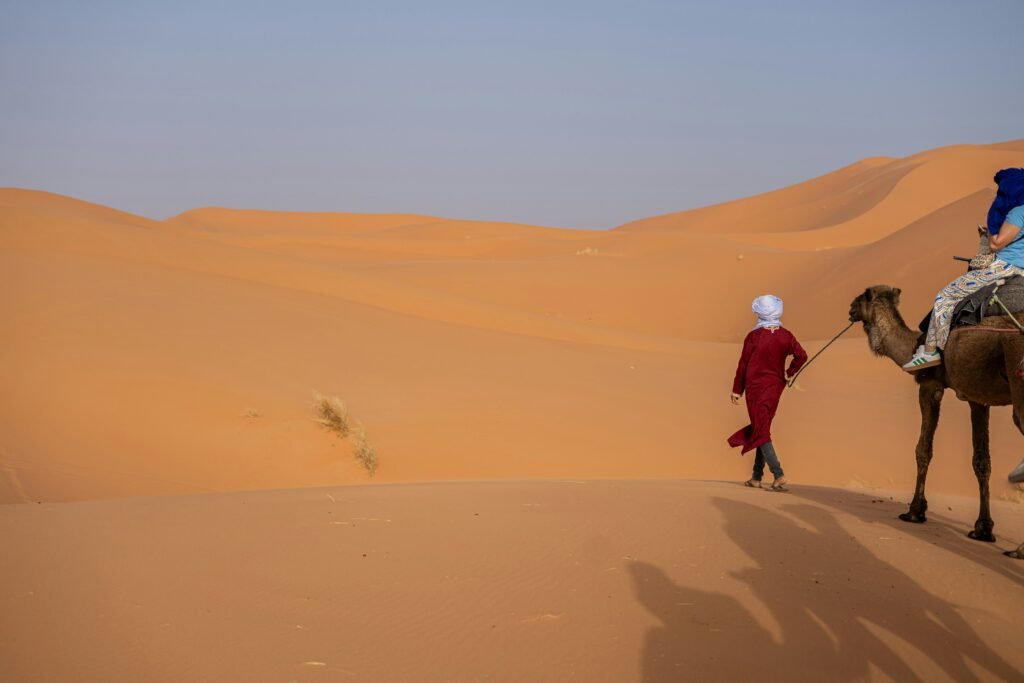
On arrival in the camp area, we prepare for the arranged camel ride near Zagora. The excursion offers a slower way to experience the surroundings after a day on the road. Its timing depends on arrival, the season, and local conditions.
The desert around Zagora features rocky plains, dry landscapes, and areas of smaller dunes. Travelers should expect this varied environment rather than the towering sand dunes associated with Erg Chebbi near Merzouga.
At camp, we settle into our accommodation and enjoy dinner. The evening provides time to relax outdoors and appreciate the quieter surroundings. Clear skies may offer opportunities for stargazing, although visibility depends on weather and moonlight.
Camp facilities vary, so we confirm the tent category and bathroom arrangements before booking.
Day 2: Zagora – Draa Valley – Ouarzazate – High Atlas – Marrakech
Early Morning in the Desert
We begin the second day with the peaceful atmosphere of the camp surroundings. Travelers who wish to rise early can enjoy the changing morning light before breakfast.
Sunrise colors depend on the weather, but the early hours offer a different perspective on the landscape. Cooler air, soft shadows, and quieter surroundings make this a pleasant time for a short walk or photographs.
After breakfast, we prepare for the return journey. The transfer from camp to the vehicle follows the arrangements confirmed for your tour.
Return through the Draa Valley
We retrace the route through the Draa Valley toward Ouarzazate, seeing the palm groves and villages in a different light.
Although we travel along familiar stretches, the return journey offers fresh views of the mountains and settlements. We include practical breaks while maintaining enough time for the High Atlas crossing.
Lunch is taken en route, with the stop selected according to our progress and the day’s travel conditions.
Crossing the Atlas Mountains to Marrakech
The final stage takes us back across the High Atlas Mountains. We follow the mountain road toward Marrakech, with opportunities to enjoy the scenery during the journey.
Arrival is generally planned for the evening, but the exact time depends on traffic, weather, road conditions, and the duration of stops. We recommend keeping your arrival evening flexible, particularly if considering restaurant reservations or onward transport.
The tour ends at the agreed drop-off point in Marrakech.